Digitize Core Analysis Scans to Excel
Legacy well files often include scanned core analysis reports from Core Lab and other labs. The tables have the numbers you need (porosity, permeability, saturations), but they sit as PDF, TIFF, PNG, or JPEG until someone retypes them.
NDepth digitizes those routine core analysis (RCA) tables into Excel or CSV so petrophysicists can load them instead of keying them.
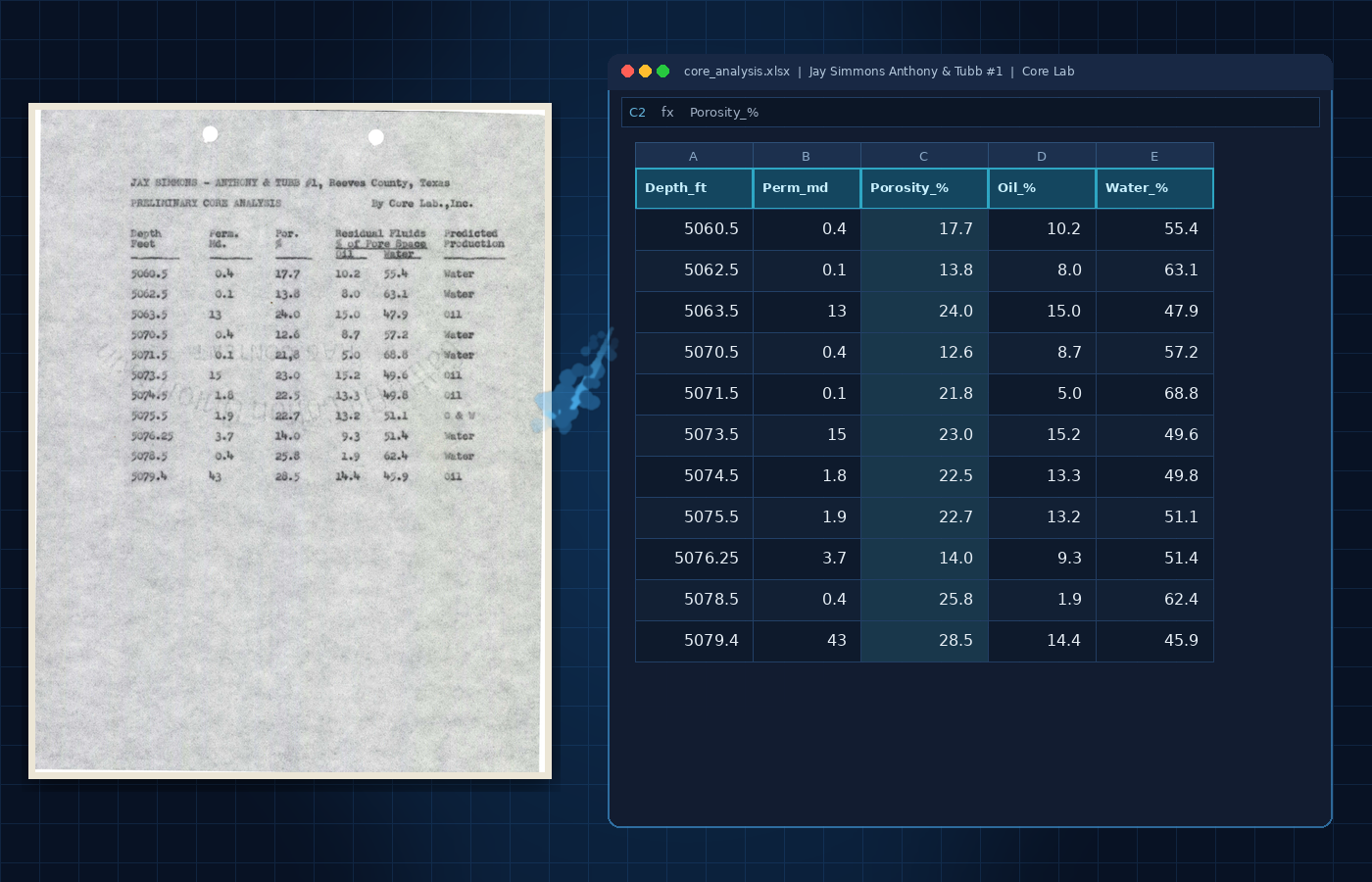
Routine Core Analysis (RCA) vs Root Cause Analysis
In oil and gas, RCA almost always means routine core analysis, not business root-cause analysis. An RCA table typically includes:
- Sample number and depth (ft)
- Porosity (%)
- Permeability (md; air / Klinkenberg when present)
- Grain density (g/cc)
- Residual oil and water saturation (% pore space)
- Lithology / description
Search terms that map to this job: core analysis PDF, core analysis PDF to Excel, core analysis TIFF, digitize RCA tables, routine core analysis Excel.
What NDepth Extracts from Scanned Core Reports
NDepth is a self-service digitizer (not tables-only). Upload common scan formats: PDF, TIFF, PNG, JPEG (including multi-page and degraded scans).
- Raster well logs → LAS
- Core analysis / RCA, mud logs, DSTs, and other G&G tables → Excel / CSV
For core analysis reports, extraction targets the columns above, plus well metadata (API, well name, operator, lab, formation) for Petrel, Kingdom, or a corporate store.
Also supported on the same path: sidewall core, SCAL-style tables, mud log strips, DST recoveries, completion tables. Each type uses a dedicated extraction model, not generic OCR alone.
How Core Analysis Table Extraction Works
- OCR and page cleanup (rotation, deskew, contrast, columns)
- Structure classification (table vs plot vs photo vs form)
- Table-type classification (core analysis vs mud log, etc.)
- Cell extraction (depth continuity, ditto marks, multi-page merge)
- Dedup across overlapping pages
- QC against geological ranges (e.g. porosity 0-40%, grain density ~2.0-3.5 g/cc)
Bulk Digitization for Data Rooms and A&D
For multi-well data rooms or A&D evaluations, upload batches of core analysis scans in parallel. The goal is structured RCA tables ready for G&G review, not overnight copy-paste.
On a prior E&P project, NthDS classified ~100,000 documents in a week and completed tabular work for ~3,500 wells / 30,000 pages in 45 days, with ~30% lower projected cost. Case study: AI metadata digitizing.
Self-serve jobs are usually under a minute per file; batches of 100+ documents are supported. Platform processing: 73,000+ wells.
Which Product to Use
- Self-serve well log → LAS, or core analysis scan → Excel: NDepth
- High-volume on-prem curve digitization and QC: Nspect
- Buy LAS / metadata by the well: NDEX
- Search a full legacy well-file corpus: Crawler
FAQ
How do I convert a core analysis PDF or TIFF to Excel?
Upload a scanned report (PDF, TIFF, PNG, or JPEG) on NDepth. Download Excel (.xlsx) or CSV with depth, porosity, permeability, and saturations.
What is RCA in oil and gas core analysis?
Routine core analysis: porosity, permeability, grain density, and saturations by depth. Not root cause analysis.
Can NDepth digitize well logs and core analysis reports?
Yes. Well logs → LAS. Core analysis / RCA / mud logs / DSTs → Excel or CSV. Same formats: PDF, TIFF, PNG, JPEG.
Does NDepth work on poor-quality scanned core reports?
Yes. Deskew, contrast enhancement, OCR, and automatic re-processing of low-confidence pages.
Start with a Core Analysis Scan
Upload a routine core analysis PDF, TIFF, or image on NDepth or register. Review in QC, export Excel/CSV. $10 free credit, no card required.
Larger batch? Request a demo.